
NEDA Job Fair opens doors for early-career scientists and engineers
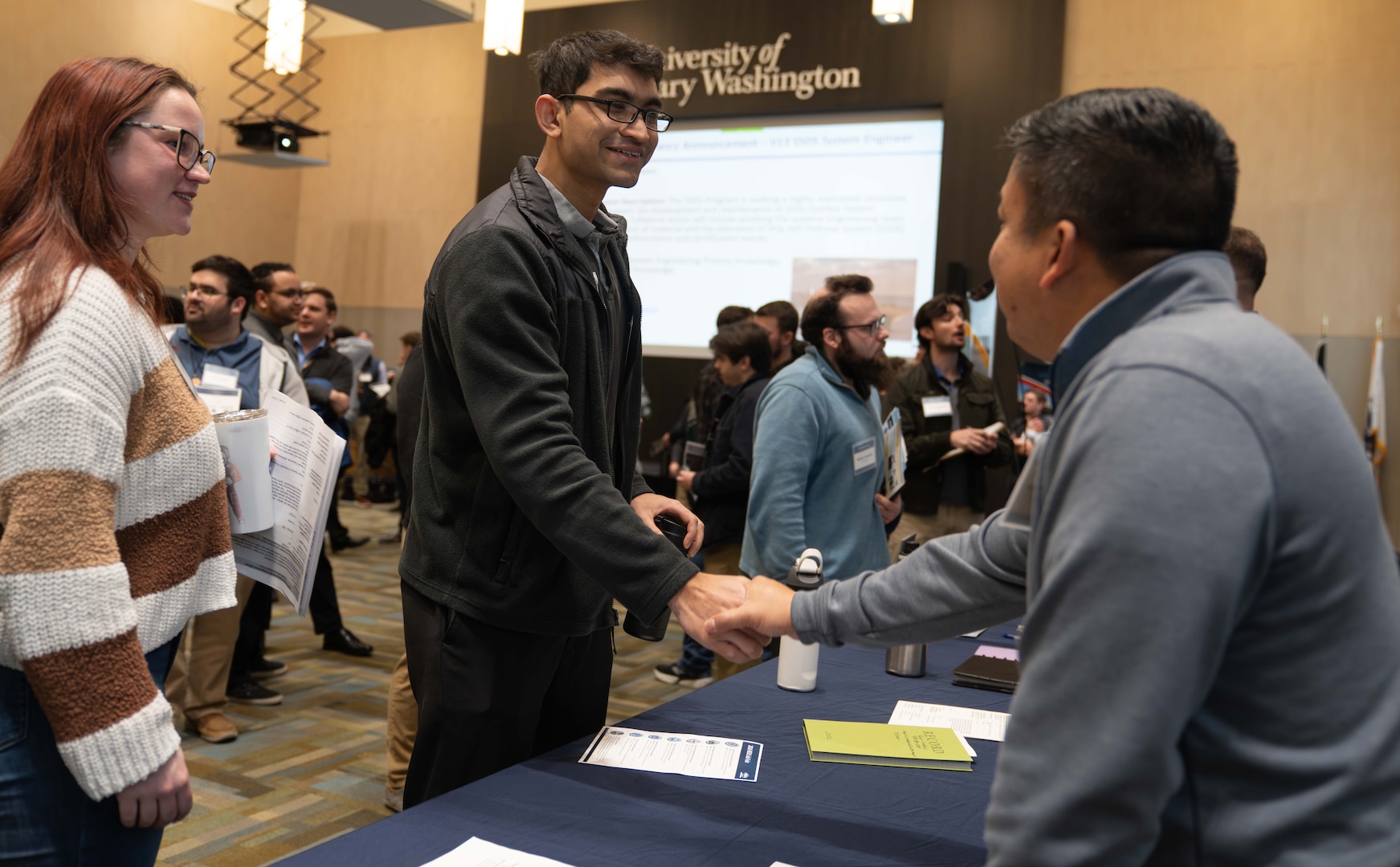
As an instrumentation engineer at Naval Surface Warfare Center Dahlgren Division, Corey Curtis spends most of his days on the range testing the systems Sailors rely on.
“On the range, we see the end product and whether it works or doesn’t,” said Curtis, who began his full-time career at NSWCDD in 2024. If it doesn’t, the system is sent back and often returned for additional testing.
What Curtis doesn’t see is the engineering work that happens long before a system ever reaches the range.
That gap is exactly what New Employment Development Assignments—called NEDA for short—are designed to address. The program gives scientists and engineers within their first three years at Dahlgren Division the opportunity to take on temporary assignments outside their home department, gaining a broader perspective of NSWCDD missions and operations. For Curtis, a NEDA could mean learning what happens earlier in the lifecycle—before systems arrive for testing—while building new technical skills and professional connections along the way.
On Feb. 12, NSWCDD Workforce Development hosted its third annual NEDA Job Fair at the University of Mary Washington Dahlgren campus, drawing approximately 150 early-career scientists and engineers—including Curtis—to connect directly with representatives from each technical department and corporate operations to explore which NEDA opportunities might help fill those knowledge gaps.
“It’s like a car assembly line,” said Susan Botkin, workforce development department head. “If my job is to install the brakes, I would probably do that better if I understood how the tires were installed. We don’t want our engineers and scientists to get siloed—we want them to be really well-rounded.”
NSWCDD Technical Director Shawna McCreary, SES, who kicked off the event, reflected on arriving at Dahlgren Division as a 19-year-old cooperative education student.
“One of the things that attracted me to Dahlgren was the importance placed on training, education and opportunities for growth,” McCreary said. “Those things were foundational then, and they continue today.”
After joining NSWCDD full time, McCreary took on several temporary assignments, including spending three to four months working on the Tomahawk program.
“It was a great experience,” she said. “You meet different people, learn different ways programs are run, different processes and different sponsors.”
With more than 700 individual projects underway across the command, McCreary emphasized that opportunities for growth are abundant for those willing to explore them.
“If there’s something you want to do differently, the opportunities are here,” she said. “Leadership’s goal is to keep you smart, talented and here. Keep your eyes open and see what interests you.”
Botkin noted that while opportunities are plentiful, many new employees aren’t aware of them without a venue like the NEDA Job Fair.
“This gives scientists and engineers who are relatively new to the organization the chance to network and really interface with the people offering these opportunities,” she said.
That was the case for Isaac Montrief, who has spent much of the last four years with the Integrated Engagement Systems Department. Montrief came to NSWCDD through the STEM Student Employment Program and began working full time in June 2025.
“I’m trying to meet new people and see what they do,” Montrief said. “Right now, I have a pretty narrow view of what goes on here.”
Approximately 60 representatives from NSWCDD technical departments—each required to offer multiple NEDA opportunities—participated in the job fair. Among them was Josh Hoover, branch head for critical infrastructure analysis in the Strategic and Computing Systems Department.
“I’m looking to place young employees in the right areas based on their skills and interests,” Hoover said.
Denesha Parker, NEDA program manager, said the goal of the event is simple: connection and clarity.
“We’re hoping attendees leave well-informed, with insight into day-to-day operations across the command, and ultimately take on a NEDA that benefits their career,” Parker said. “That’s the heart of this.”
McCreary encouraged early-career employees to view NEDAs as a foundation rather than a detour.
“After completing a rotation, go back to your home branch, spend time really understanding how that program works and build a strong technical foundation,” she said. “From there, your career can go any direction you want right here at Dahlgren. I’m excited to see our future workforce, and I hope to see you here in 10 years.”
For Curtis, the job fair offered a first look at how a NEDA could help bridge the gap between testing what works on the range and understanding everything that makes it work long before it gets there.